



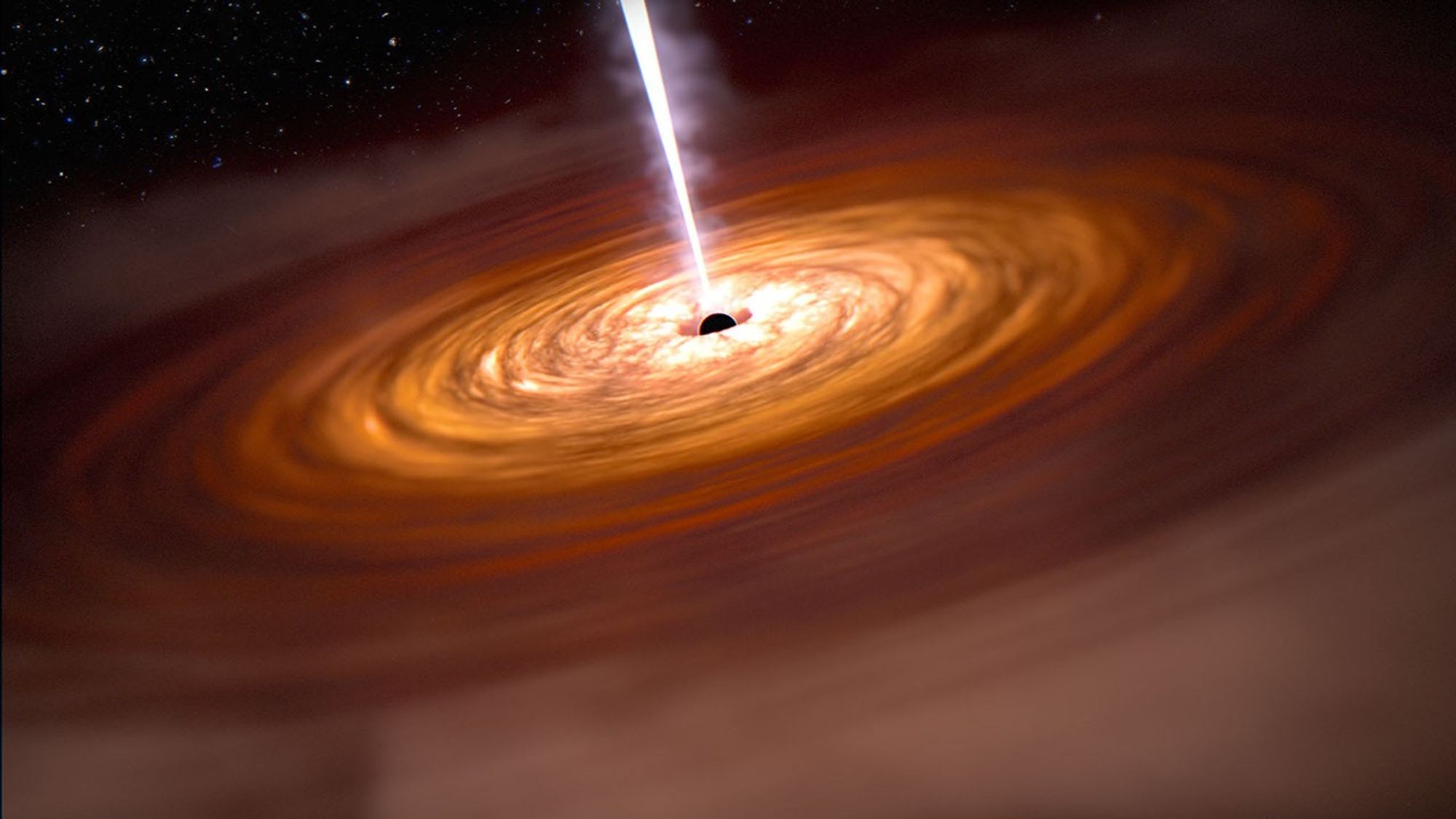
Black Holes: What They Are and Their Properties.
The Architecture of the Abyss: A Deep Dive into Black Holes
1. Genesis and the Absolute Limit
A black hole is not merely an object; it is a region where the fabric of the universe has been punctured by the sheer weight of matter. Its existence begins with the catastrophic death of a massive star. When a star with a mass at least 20 times that of our Sun exhausts its nuclear fuel, the delicate balance between the outward push of fusion and the inward pull of gravity shatters. The core collapses in milliseconds. If the remaining mass exceeds the Tolman-Oppenheimer-Volkoff limit (approximately 2.2 to 3 solar masses), no known force in nature—not even the quantum degeneracy pressure of neutrons—can halt the collapse.
The result is a region of spacetime curved so severely that it becomes a "bottomless well." At the boundary of this well lies the Event Horizon, the point of no return. This is not a solid surface, but a mathematical boundary where the escape velocity equals the speed of light ($c$). According to General Relativity, space itself flows inward across this boundary faster than light can travel outward. To cross the horizon is to be causally disconnected from the rest of the universe; it is a one-way door into the unknown.
2. [1][2] Structural Dynamics: The Ringularity and the Ergosphere [3]
While popular imagery depicts black holes as simple dark spheres, their internal structure is complex and dynamic. Most black holes in the universe are rotating, a property inherited from their parent stars. These are known as Kerr black holes. [4] In a Kerr black hole, the singularity at the center is not a zero-dimensional point, but a one-dimensional ring known as a "ringularity." [3][5] This ring possesses zero thickness but a non-zero radius, maintained by the centrifugal force of its intense spin.
Surrounding the event horizon of a rotating black hole is the ergosphere, a region where spacetime is dragged along with the black hole's rotation—a phenomenon called "frame-dragging." In the ergosphere, it is physically impossible to stand still; space itself is moving at relativistic speeds. However, unlike the event horizon, escape from the ergosphere is still possible. In fact, theoretical physics suggests that advanced civilizations could extract energy from a black hole by dipping into the ergosphere and escaping with more energy than they entered with, a concept known as the Penrose Process.
3. Thermodynamics and the Quantum Frontier
For decades, black holes were thought to be inert, cold prisons. This changed in 1974 when Stephen Hawking applied quantum field theory to the curved spacetime near the horizon. He discovered that black holes are not truly black; they emit thermal radiation, now called Hawking Radiation. This occurs due to quantum fluctuations in the vacuum of space, where virtual particle pairs constantly pop into existence. Near the horizon, one particle may fall in while its partner escapes. [6] The escaping particle becomes real radiation, while the infalling particle contributes negative energy, effectively reducing the black hole's mass. [6]
This discovery introduced a profound paradox: The Information Paradox. In quantum mechanics, information (the state of particles) is never destroyed. However, if a black hole evaporates completely via Hawking Radiation, the information about everything that ever fell inside appears to be erased from the universe. Recent theoretical breakthroughs in 2024 and 2025, utilizing the "Holographic Principle," suggest that this information might be encoded on the 2D surface of the event horizon or preserved in the radiation itself through complex quantum entanglement, hinting that the universe may operate like a vast hologram.
4. The Era of Direct Observation: 2024-2026
We have moved from the era of theory to the era of direct observation. The Event Horizon Telescope (EHT) has provided us with the first visual evidence of black holes (M87* and Sagittarius A*), revealing the "shadow" cast by the horizon against the glowing accretion disk. These images confirm Einstein’s predictions with terrifying accuracy. Furthermore, the NANOGrav collaboration has recently detected a background hum of gravitational waves, likely caused by the slow inspiral of supermassive black hole binaries across the cosmos, confirming that the universe is agitated by the movements of these giants.
Most significantly, the James Webb Space Telescope (JWST) has recently identified "Little Red Dots" in the early universe (just 500 million years after the Big Bang). These objects appear to be over-massive black holes that exist far too early to have formed from dying stars. [7] This evidence supports the "Direct Collapse" theory, suggesting that in the dawn of time, massive clouds of pristine gas collapsed directly into black holes, bypassing the star stage entirely. This rewrites the history of cosmic evolution, placing black holes as the architects, rather than the products, of the first galaxies.