


Easy Crochet Projects: Scarves, Simple Hats, Coasters.
The Architecture of Loops: A Technical and Psychological Analysis of Fundamental Crochet Projects
Introduction: The Intersection of Craft, History, and Neuroplasticity
Crochet is frequently dismissed as a mere domestic pastime, yet a deeper analysis reveals it to be a complex interplay of geometry, material science, and cognitive therapy. Far from its humble origins—often traced by historians to the 19th-century shepherd’s knitting or the desperate industry of the Irish Potato Famine where it served as a survival trade—modern crochet has evolved into a sophisticated discipline. It is a craft that requires the practitioner to function simultaneously as an architect and a builder, constructing fabric one loop at a time. Unlike knitting, which maintains multiple live stitches on a needle, crochet typically isolates a single active stitch, offering a unique structural integrity and freedom of movement.
Beyond the textile production, the act of crocheting engages the brain in a process known as "flow," a state of deep absorption that psychologists associate with reduced anxiety and increased neuroplasticity. The repetitive fine motor movements required to manipulate the hook and yarn stimulate the release of serotonin and dopamine, functioning similarly to meditation. When a beginner embarks on foundational projects such as scarves, hats, or coasters, they are not merely creating accessories; they are engaging in a historical continuum and a mental exercise that enhances focus and mathematical intuition. These three specific projects—the scarf, the hat, and the coaster—serve as the perfect pedagogical triad, introducing the novice to the three geometric planes of the craft: the flat rectangle, the cylinder, and the radial circle.
Material Science: The Physics of Fiber and Tool Selection
The success of any crochet project is predetermined by the selection of materials, a decision that requires an understanding of fiber physics rather than just aesthetic preference. For a novice, the debate often centers on three primary fiber types: acrylic, wool, and cotton. Acrylic, a synthetic polymer derived from petroleum, is the most accessible. It is hydrophobic (repels water) and durable, making it excellent for beginners who may need to "frog" (rip out) their work repeatedly. However, its plastic nature means it lacks breathability and, critically, is flammable and prone to melting under high heat. This makes acrylic a poor choice for kitchen items like coasters or potholders, where thermal resistance is paramount.
Conversely, cotton is a cellulosic fiber with high absorbency and heat tolerance, making it the mandatory material for coasters. It does not stretch significantly, which forces the crafter to maintain consistent tension manually. Wool, a protein fiber, offers elasticity and memory, meaning it can stretch and return to its original shape. This property is vital for wearables like hats, which require negative ease to fit snugly against the head. Furthermore, the tool itself—the crochet hook—dictates the ergonomics of the work. While traditional aluminum hooks are standard, modern ergonomic hooks with elastomer handles are engineered to reduce the strain on the carpal tunnel, allowing for the prolonged repetitive motion necessary to complete larger surface areas like scarves without injury.
The Geometry of the Rectangle: The Scarf as a Study in Tension and Rows
The scarf represents the linear plane in crochet geometry. While it appears deceptively simple, the scarf is the ultimate testing ground for "gauge"—the number of stitches and rows per inch. A scarf is constructed by stacking rows of stitches, a process that introduces the critical concept of the "turning chain." In crochet architecture, stitches have specific heights; a single crochet is one unit high, while a double crochet is roughly three units high. To move from one row to the next without distorting the edge, the crafter must create a chain "elevator" to reach the correct height before turning the work. Failing to understand this architectural necessity results in the common beginner error of trapezoidal scarves, where edges bow inward or flare outward.
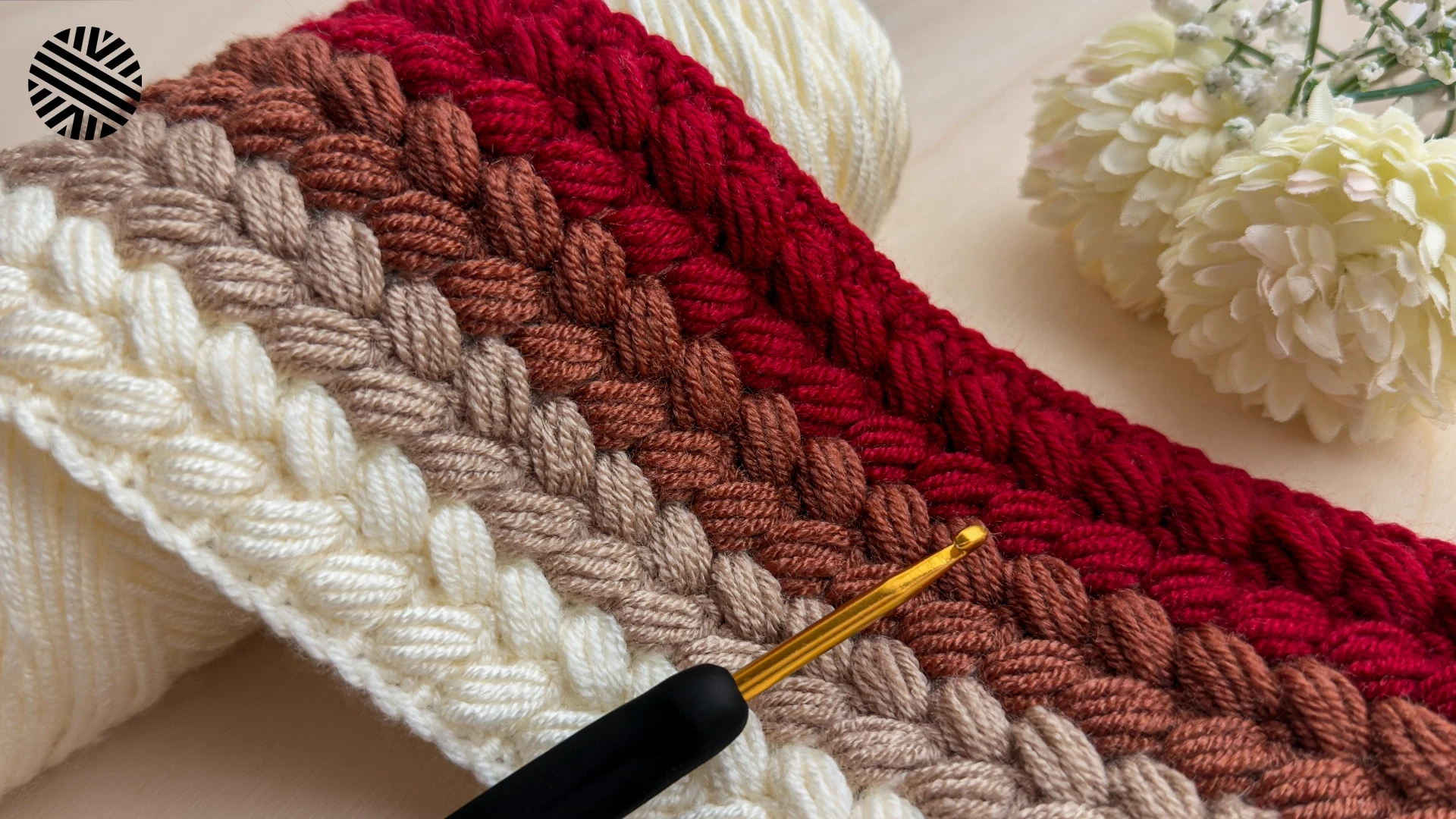
Furthermore, the scarf allows for the exploration of texture through loop manipulation. By inserting the hook only into the "Back Loop Only" (BLO) of the V-shaped stitch, the crafter pushes the front loop forward, creating horizontal ridges. This technique mimics the ribbing found in knitting and adds elasticity to the fabric. This is not merely a visual trick but a structural alteration; it changes the drape and thermal properties of the scarf by trapping more air within the ridges. Mastering the scarf is, therefore, mastering the grid; it is the discipline of keeping edges straight and tension consistent over thousands of identical movements, a practice that solidifies muscle memory.
Radial Symmetry and Cylindrical Forms: Hats and Coasters
Moving from the scarf to hats and coasters requires a shift from Cartesian coordinates (rows and columns) to polar coordinates (working in the round). The coaster is the practical application of the mathematical constant Pi ($\pi$). To create a flat circle, the crafter must increase the number of stitches in each round by a specific formula. [1] If the circumference does not expand at a rate consistent with $\pi$ (roughly 3.14 times the diameter), the fabric will distort. Too few increases cause the edges to curl up into a cup (spherical geometry); too many increases cause the fabric to ruffle (hyperbolic geometry). For a standard double crochet circle, this typically means starting with 12 stitches and adding 12 stitches every subsequent round. [1] This mathematical precision is what separates a functional coaster from a misshapen scrap of yarn.
Hats, specifically the "beanie," combine the logic of the rectangle and the circle. A simple hat can be constructed by crocheting a rectangle (using the ribbing technique mentioned above) and sewing the short ends together to form a cylinder. The top is then cinched, relying on the flexibility of the yarn to close the gap. Alternatively, a hat can be worked from the top down, starting with a small circle (like a coaster) and stopping the increases once the diameter reaches the measurement of the wearer's head divided by $\pi$. This transition from increasing (creating the crown) to working even (creating the sides) demonstrates how changing the math of the stitch count alters the three-dimensional topology of the object.