



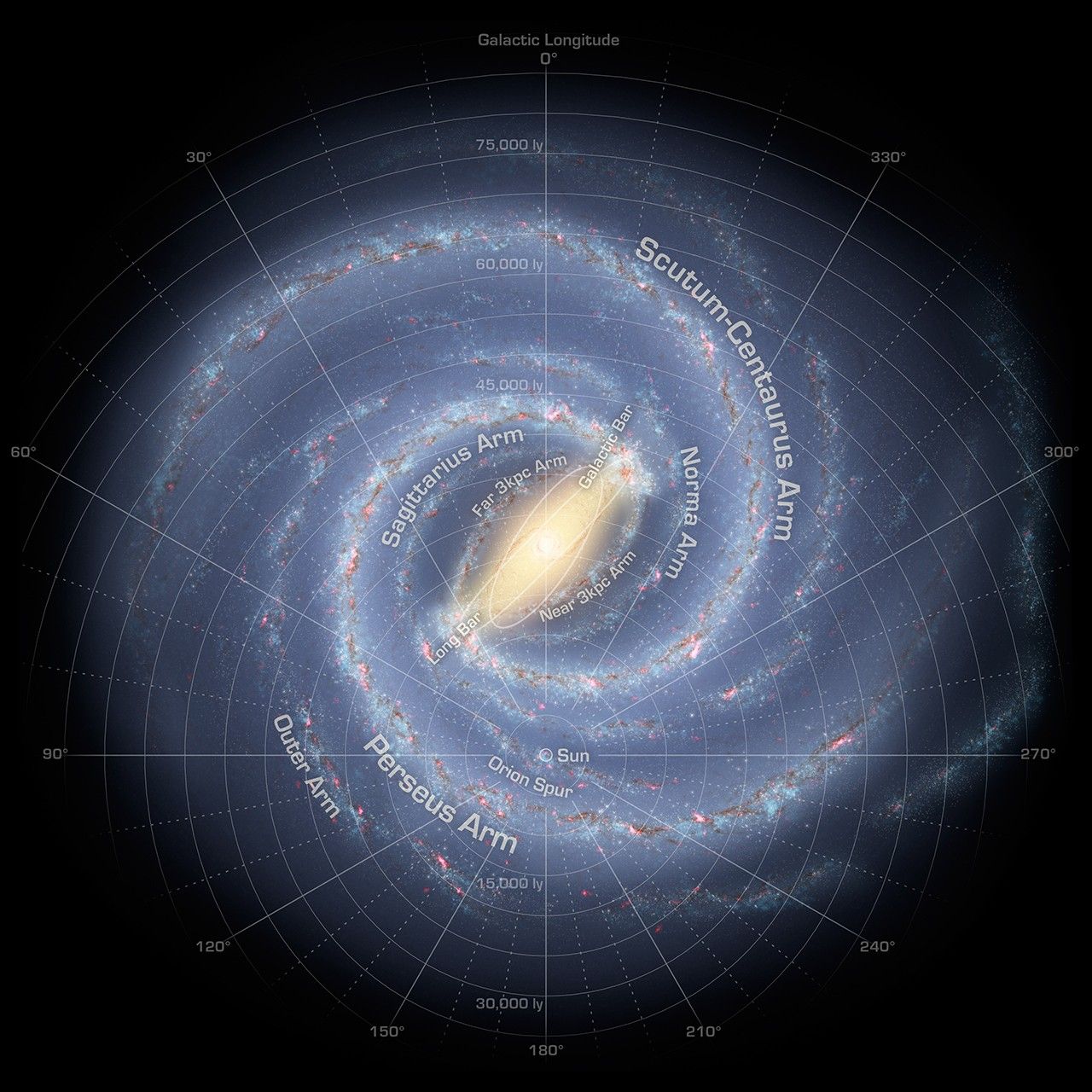
Galaxies and Their Types (The Milky Way).
Galactic Architectures: A Comprehensive Analysis of Cosmic Structure and the Milky Way
The Fundamental Nature of Galactic Systems
The universe is not a uniform distribution of matter; it is an archipelago of gravitationally bound systems known as galaxies. These structures are the fundamental units of cosmic organization, ranging from dwarf spheroids containing a mere 10 million stars to supergiant ellipticals housing over 100 trillion. However, a galaxy is defined by more than its visible stellar inventory. Modern astrophysics reveals that the visible matter—stars, interstellar gas, and dust—constitutes only a fraction of a galaxy's total mass. The structural integrity of these systems is maintained by dark matter, an invisible halo that extends far beyond the luminous disk, providing the gravitational glue necessary to prevent rotational disintegration.
The formation of these systems remains one of cosmology’s most dynamic fields of study. While the standard hierarchical model suggests galaxies formed slowly through the gradual accumulation of gas and smaller mergers, recent data from the James Webb Space Telescope (JWST) has disrupted this timeline. Observations in 2024 identified "mature" barred spiral galaxies existing when the universe was only 25% of its current age. This evidence suggests that the physical processes governing galactic organization—specifically the settling of gas into rotating disks and the formation of central bars—occur much more rapidly than theoretical models previously allowed. This shift in understanding forces a re-evaluation of how the early universe transitioned from a chaotic plasma to the orderly, structured cosmos observed today.
The Hubble Sequence: Morphology as Evolutionary History
Astronomers classify galaxies using the Hubble Tuning Fork, a system that categorizes them by visual morphology. [1] This classification is not merely aesthetic; it serves as a proxy for a galaxy's evolutionary history and star-forming potential. Spiral galaxies, such as the Whirlpool Galaxy (M51), are characterized by flat, rotating disks and distinct spiral arms. These arms are not static structures but density waves—regions of higher gravity that compress interstellar gas as they rotate, triggering the collapse of molecular clouds into new stars. Consequently, spiral arms appear blue and luminous, dominated by short-lived, high-mass Population I stars. These galaxies are "living" systems, actively converting gas into stellar matter.
In stark contrast, Elliptical galaxies (Type E) represent the "retirement homes" of the cosmos. Ranging from spherical to cigar-shaped, these galaxies lack the cool gas and dust required for star formation. Their stellar populations are dominated by old, red, low-mass stars (Population II) that move in random, swarm-like orbits rather than an orderly disk. The prevailing hypothesis is that giant ellipticals are the wreckage of galactic collisions. When two spiral galaxies merge, their delicate disks are destroyed, their gas reserves are stripped or consumed in a starburst frenzy, and the remaining stars settle into an ellipsoidal shape. [2] Lenticular galaxies (Type S0) serve as a transitional form, possessing a central bulge and disk like a spiral, but lacking arms and new star formation, suggesting they are faded spirals that have exhausted their fuel.
The Milky Way: Anatomy of a Barred Spiral
Our home, the Milky Way, is a textbook example of a highly evolved SBbc Barred Spiral galaxy. It is a vast, rotating city of stars approximately 100,000 light-years in visible diameter, though its dark matter halo extends nearly 2 million light-years. Unlike a standard spiral, the Milky Way possesses a rectangular "bar" of old, red stars cutting through its center. This bar acts as a cosmic funnel, channeling gas from the outer disk into the galactic core, fueling the central bulge and occasionally feeding the supermassive black hole, Sagittarius A* (Sgr A*). Sgr A* is a gravitational anchor with a mass equivalent to 4.1 million Suns, yet it is relatively quiescent compared to the active galactic nuclei seen in distant quasars.
The Sun resides in the Orion Spur, a minor bridge of stars located between the major Sagittarius and Perseus arms, roughly 26,000 light-years from the galactic center. From this vantage point, we orbit the core at approximately 828,000 kilometers per hour, completing one "galactic year" every 230 to 250 million years. Recent astrometric data from the Gaia mission has revealed that the Milky Way’s disk is not perfectly flat but is warped and twisted at the edges, resembling a vinyl record left in the heat. This warping is attributed to the gravitational torque exerted by the Large Magellanic Cloud (LMC), a satellite galaxy currently orbiting us. This interaction highlights that the Milky Way is not an isolated island but a dynamic system constantly shaped by its local environment.
Galactic Dynamics: Cannibalism and the Local Group Fate
Galaxies are not static objects; they grow through "galactic cannibalism," a process where massive galaxies shred and assimilate smaller dwarf neighbors. The Milky Way is currently digesting the Sagittarius Dwarf Spheroidal Galaxy, leaving distinct streams of stars wrapped around our galaxy’s polar regions. Furthermore, the Magellanic Clouds are falling inward, destined to eventually merge with our halo. These interactions replenish the Milky Way’s supply of gas, ensuring that star formation can continue for billions of years, albeit at a slowly declinating rate.
Looking toward the deep future, the fate of the Milky Way is tied to the Andromeda Galaxy (M31), our largest neighbor in the Local Group. For decades, a collision between the two was viewed as an inevitability. [3] However, sophisticated simulations published in the 2024-2025 period have introduced a "coin flip" probability to this scenario. When accounting for the chaotic gravitational perturbations of the Large Magellanic Cloud and the Triangulum Galaxy (M33), the certainty of a head-on collision drops to approximately 50% within the next 10 billion years. It is equally plausible that the Milky Way and Andromeda will execute a near-miss, sideswiping each other and settling into a long-distance orbit. Whether we merge to form a giant elliptical "Milkomeda" or remain distinct spirals, the local cosmic geography is destined for radical transformation.