


Granny Squares Crochet: Techniques and Diverse Applications.
Historical Genesis and the Fractal Geometry of the Motif
The granny square is far more than a domestic relic; it is a sophisticated modular system of textile engineering that dates back to the late 19th century. Contrary to the popular myth that it originated as a desperate measure for pioneers to use scrap yarn, the first recorded pattern appeared in the April 1885 issue of Prairie Farmer magazine. Authored by a Mrs. Phelps, the "Crazy Afghan" pattern was inspired by the "crazy quilt" trend of the era, characterized by asymmetrical, vibrant patches. [3] This historical pivot transformed crochet from a medium primarily used for delicate lace into a structural tool for creating robust, three-dimensional textiles. The fundamental "granny cluster"—typically a grouping of three double crochet stitches—creates a breathable yet sturdy fabric that expands outward in a fractal-like progression.
Mathematically, the granny square is a masterpiece of geometric efficiency. By utilizing "chain spaces" at the corners to facilitate a 90-degree turn, the maker ensures the fabric remains flat regardless of how many rounds are added. This scalability is the square’s greatest asset; a single motif can serve as a coaster, while a collection of hundreds can form a king-sized bedspread. The structural integrity of the square relies on the tension between the dense clusters and the open "spaces," a balance that allows the finished textile to drape elegantly without losing its shape. This geometric foundation has allowed the craft to survive for over 140 years, evolving from the simple "Mrs. Phelps" square into thousands of variations, including sunbursts, hexagons, and textured 3D floral motifs.
The Technical Paradox: Manual Mastery vs. Industrial ImpossibilityIn an era of total industrial automation, crochet—and specifically the granny square—occupies a unique economic position: it cannot be replicated by machines. While knitting machines have existed since the 16th century, the mechanics of crochet are too complex for modern robotics to mimic efficiently. Research into textile automation reveals that a single basic crochet stitch involves approximately 28 distinct movements across nine axes of motion. [4] Unlike knitting, which is a series of simple interlocking loops, crochet requires the hook to pull yarn through a closed loop and then anchor it into a specific, non-linear point in the fabric. This "un-machineable" quality means that every granny square garment found in a luxury boutique or a fast-fashion outlet is, by definition, handmade.
This technical limitation has profound implications for the business of fashion. Brands like JW Anderson and Dolce & Gabbana have leaned into this "hand-feel" as a marker of luxury and authenticity. [1] For instance, the viral JW Anderson patchwork cardigan—which sparked a global "crochet-core" movement—relied on the modularity of the granny square to create a high-fashion silhouette that was simultaneously accessible to home crafters. Because each piece requires significant human labor hours, the granny square has become the face of the "Slow Fashion" movement. It stands as a defiance against the disposable nature of modern textiles, where the value of the item is intrinsically linked to the manual dexterity and time invested by the artisan.
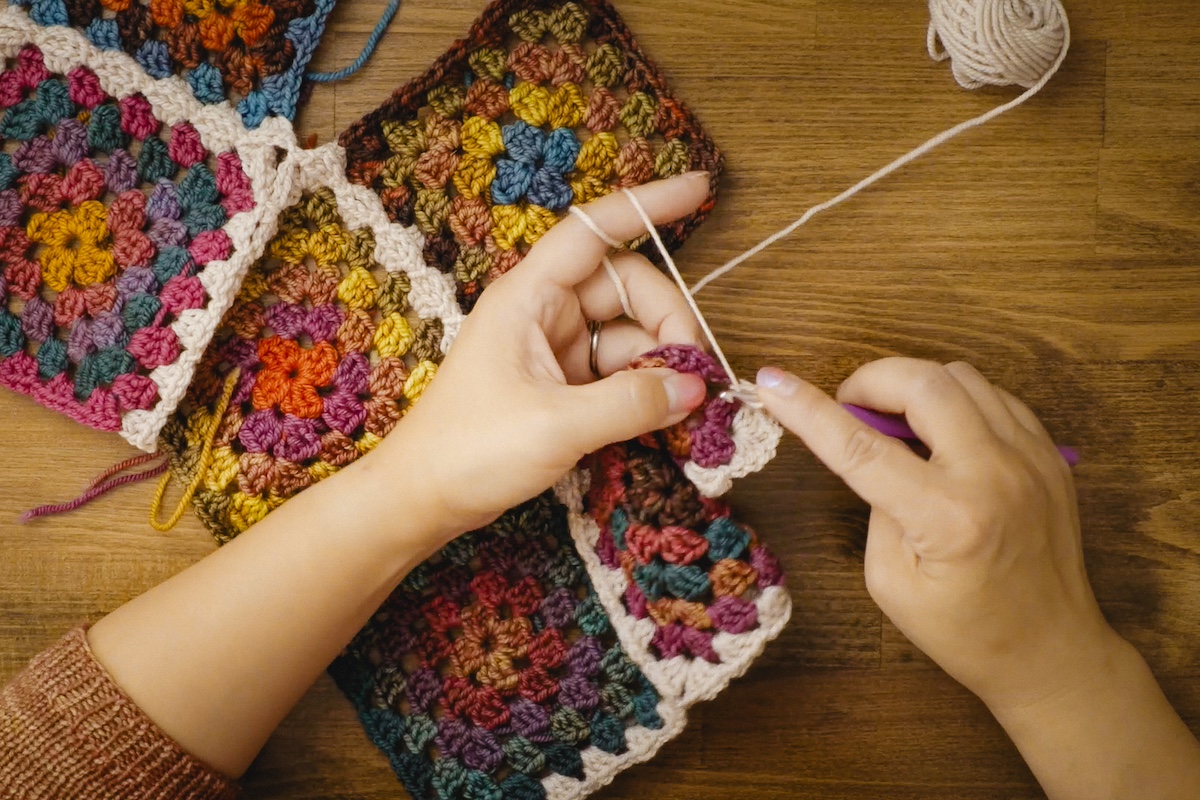
Advanced Assembly Methodologies and the Digital Pattern EconomyThe professionalization of the granny square is most evident in the evolution of assembly techniques. The transition from a "hobbyist" look to a "designer" finish often depends on the method of joining. While the traditional whip stitch is functional, advanced practitioners utilize the "Join-As-You-Go" (JAYG) method or the "Mattress Stitch." The JAYG technique is particularly revolutionary in a business context; it allows the artisan to connect motifs during the final round of stitching, creating a seamless, fluid fabric that lacks the bulk of traditional seams. Furthermore, the practice of "blocking"—the process of pinning squares to a specific dimension and applying steam or moisture—is a non-negotiable step in professional production. Blocking ensures that every module is identical, allowing for the mathematical precision required in garment construction.
This technical rigor has fueled a thriving "digital pattern economy." [1] Platforms such as Ravelry and Etsy have empowered independent designers to monetize their intellectual property. [1] A single innovative granny square design can generate significant revenue; for example, top-tier designers on these platforms report thousands of sales for individual PDF patterns. This marketplace has shifted the focus from selling physical goods to selling "technical instructions," allowing for a scalable business model that bypasses the logistical hurdles of shipping physical products. The data from these platforms suggests that the granny square is the most searched-for motif, proving its enduring marketability in the 21st-century craft sector.
Socio-Cultural Impact: Therapeutic Utility and SustainabilityBeyond its economic and technical merits, the granny square serves a critical role in public health and community building. [1] A study published in the British Journal of Occupational Therapy involving over 3,500 participants found that the repetitive, rhythmic nature of crochet significantly correlates with increased serotonin levels and reduced anxiety. [2] The "micro-goal" structure of the granny square—where a single unit can be completed in 15 to 30 minutes—provides a frequent "dopamine hit" of accomplishment, making it a powerful tool for managing depression and chronic stress. In clinical settings, "crochet therapy" is increasingly used to improve fine motor skills in the elderly and to provide a meditative outlet for patients dealing with trauma.
Furthermore, the granny square is a pillar of environmental sustainability. Its modular nature makes it the ultimate "zero-waste" technique. Unlike traditional garment cutting, which leaves behind fabric scraps, crochet uses every inch of yarn. In a real-world application of the circular economy, many designers now use "reclaimed" yarn from unraveled thrift store sweaters to create high-end granny square apparel. This "upcycling" potential, combined with the longevity of the hand-stitched fabric, positions the granny square as a solution to the environmental crisis caused by the textile industry. It is a craft that honors the past through its history, serves the present through its therapeutic benefits, and protects the future through its sustainable methodology.