


How to Read Crochet Patterns and International Symbols
The Code of the Hook: Deciphering Crochet Patterns and International Logic
Crochet is often mistaken for a simple pastime, but at its structural core, it is a form of applied mathematics and engineering. To the uninitiated, a crochet pattern is a nonsensical string of abbreviations and punctuation; to the skilled artisan, it is a precise algorithm for creating three-dimensional fabric from a one-dimensional string. Mastering the ability to read these patterns—both written and charted—is the single most critical skill in the craft, transforming a hobbyist into a textile engineer. This report delves into the syntax, history, and international variations of crochet notation, providing a definitive guide to navigating this global language.
The Great Divide: US versus UK Terminology
The most immediate and perilous pitfall in reading crochet patterns is the historical schism between American (US) and British (UK) terminology. This divergence, which solidified during the 19th-century standardization of needlework, created a linguistic trap where the same word describes two different physical actions. The confusion stems from a fundamental difference in counting: US terms count the number of movements required to complete the stitch, while UK terms essentially count the number of loops on the hook after the first yarn-over.
The "Golden Rule" for decoding this is the offset principle: UK stitches are named one step "higher" than their US counterparts. For instance, the "Single Crochet" (sc), the most basic US stitch, does not exist in UK terminology; the identical stitch is called a "Double Crochet" (dc) in Britain. Consequently, a US "Double Crochet" is a UK "Treble Crochet." A crafter who fails to identify the pattern’s origin before beginning will inevitably produce a garment that is either twice the intended size or impossibly dense. The litmus test for any written pattern is simple: scan the text for the abbreviation "sc." If it appears, the pattern is American. If the smallest stitch listed is a "dc," it is almost certainly British or Australian.
The Syntax of Written Algorithms
Written patterns function like computer code, utilizing a strict syntax of abbreviations, brackets, and asterisks to compress complex instructions into a readable format. This "mathematical grammar" relies on the Order of Operations, similar to algebra. Understanding this syntax is crucial for executing complex repeats without error.
Asterisks (*) and brackets ([]) represent loops in the algorithm. An instruction reading *dc in next 3 sts, 2 dc in next st; rep from * across commands the crafter to isolate the sequence between the asterisk and the semicolon and repeat it cyclically until the row ends. Parentheses () serve a dual purpose: they either denote a group of stitches worked into a single location (creating a shell or corner) or summarize the final stitch count at the end of a row. For example, (3 dc, ch 2, 3 dc) in next sp indicates a complex cluster of architectural maneuvers all anchored to one specific point in the previous row. Mastery of this punctuation ensures the rhythm of the fabric remains consistent, as a single misplaced bracket can throw off the geometric expansion of an entire project.
The Universal Logic of Charts and Symbols
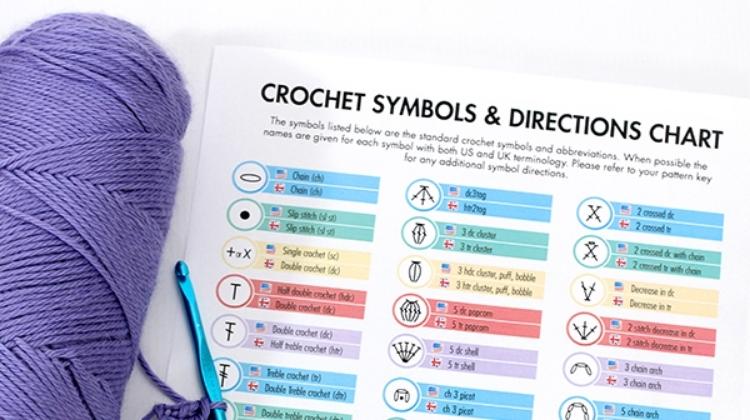
While written patterns vary by language, international charts represent the "lingua franca" of crochet. Popularized by Japanese designers who favored visual precision over verbose text, charts use standardized symbols that mimic the physical appearance of the stitches. This system is highly logical: the height of the symbol corresponds to the height of the stitch, and the cross-hatches on the stem indicate the number of yarn-overs required.
A "T" shape represents a Half-Double Crochet. [1][2] Add a diagonal slash across the stem (†), and it becomes a Double Crochet (representing one yarn-over). Two slashes indicate a Treble Crochet. [1][3] This visual logic allows a crafter in New York to instantly execute a design from a Tokyo pattern book without speaking a word of Japanese. Reading these charts requires a specific orientation: flat rows are read in a zig-zag fashion (right-to-left for row 1, left-to-right for row 2), mimicking the physical turning of the fabric. Conversely, circular motifs (like doilies or amigurumi) are read counter-clockwise from the center outward, spiraling into expansion.
Deep Dive: Russian XVA and Tunisian Variations
Beyond the standard international symbols, distinct regional notations exist that offer efficient shorthands for complex construction. Russian and Chinese patterns, particularly for amigurumi (stuffed toys), frequently utilize the "XVA" notation system. In this highly efficient shorthand, X represents a Single Crochet, V represents an Increase (two stitches in one), and A represents a Decrease (two stitches combined into one). This minimalist approach strips away the visual clutter of traditional charts, allowing for rapid reading of dense, sculptural patterns.
Furthermore, Tunisian crochet—a hybrid craft that blends crochet and knitting—possesses its own unique symbol set. Because Tunisian crochet involves holding multiple loops on the hook simultaneously (the "forward pass") and then working them off (the "return pass"), its symbols often resemble standard crochet icons but are modified to indicate vertical bars or knit-like structures. For example, a symbol that looks like a standard Double Crochet but with a hook at the top specifically denotes a Tunisian Double Crochet, instructing the user to work into the vertical bar rather than the top loops. Recognizing these subtle distinctions is vital for advanced textile work.
The Geometry of the Stitch
Ultimately, reading a crochet pattern is an exercise in applied geometry. Every instruction to "increase" or "chain" is a command to alter the curvature of the hyperbolic plane. A flat circle, for instance, requires a precise mathematical rate of expansion—typically increasing by six stitches per round for single crochet—to prevent the fabric from "cupping" into a bowl or "ruffling" like a potato chip.
When a pattern calls for [sc in next 3 sts, inc in next], it is not merely a rote instruction; it is a geometric formula designed to expand the circumference by a specific ratio relative to the radius (Pi). Advanced designers use this inherent math to create complex shapes, such as the hyperbolic planes used in coral reef modeling. Understanding that a pattern is essentially a geometric map empowers the crafter to troubleshoot errors. If a piece is not lying flat, the error is rarely in the yarn, but in the unintentional violation of the mathematical ratio dictated by the pattern's syntax.