



Stars: Their Life Cycle and Types.
Stellar Metamorphosis: The Physics of Life, Death, and Creation in the Cosmos
The Genesis of Light: Formation and Hydrostatic Equilibrium [1]
The universe is illuminated by the collective brilliance of septillions of stars, yet each begins its existence in total darkness. The life of a star commences within giant molecular clouds—colossal nurseries of cold hydrogen gas and dust that can span hundreds of light-years. These regions are initially stable, but the delicate balance is eventually disrupted by shockwaves from nearby supernovae or galactic collisions. This disturbance triggers a gravitational collapse. As the cloud fragments, gravity pulls gas inward with increasing violence, converting potential energy into kinetic energy and heat. This collapsing core, known as a protostar, is a chaotic, turbulent object not yet powered by nuclear fusion.
The transition from a protostar to a true main-sequence star is defined by the achievement of a critical physical state known as hydrostatic equilibrium. [1][2] As the core temperature climbs to approximately 10 million Kelvin, hydrogen nuclei are stripped of their electrons, creating a plasma. At this threshold, the strong nuclear force overcomes the electromagnetic repulsion between protons, igniting thermonuclear fusion. This process releases photons that exert immense outward pressure. Hydrostatic equilibrium is the precise balance between this outward thermal pressure and the crushing inward pull of gravity. [3][4] Without this equilibrium, a star would either implode or explode; instead, it stabilizes, shining steadily for millions or billions of years. This delicate stalemate between crushing gravity and explosive nuclear force is the defining characteristic of a living star, preventing the collapse that birthed it and the cataclysm that will eventually end it. [3]
The Main Sequence and the Architecture of Classification
Once a star achieves stability, it enters the Main Sequence, the longest phase of its existence, where it fuses hydrogen into helium. [2] Astronomers classify these objects using the Morgan-Keenan (MK) system, a spectral classification that sorts stars by surface temperature and color. [5] The sequence—O, B, A, F, G, K, M—ranges from the hottest, most massive blue stars (Type O) to the coolest, least massive red dwarfs (Type M). [5] This classification is not merely a labeling system but a revelation of a star’s physical properties. [4] For instance, Type O stars are rare, volatile giants with surface temperatures exceeding 30,000 Kelvin, consuming their fuel at voracious rates. In contrast, Type M stars, which make up the vast majority of the stellar population, burn their fuel so frugally that they can live for trillions of years, longer than the current age of the universe.
Our Sun is a G-type yellow dwarf, a mediocre star in terms of mass and brightness, yet it sits in the "Goldilocks" zone of stellar evolution. The behavior of a star on the main sequence is dictated almost entirely by its initial mass. Mass determines the core pressure, which dictates the rate of fusion. High-mass stars burn brighter and hotter but die young, often in just a few million years. Low-mass stars are dim and cool but possess extreme longevity. This relationship is visualized on the Hertzsprung-Russell (H-R) diagram, a scatter plot of stars showing the relationship between absolute magnitude (luminosity) and stellar classification (temperature). [6] The main sequence appears as a diagonal band where stars spend 90% of their lives. [6] Understanding this classification allows astrophysicists to predict the entire life story of a star simply by observing its light today.
The Fate of Low to Intermediate-Mass Stars: Red Giants and White Dwarfs
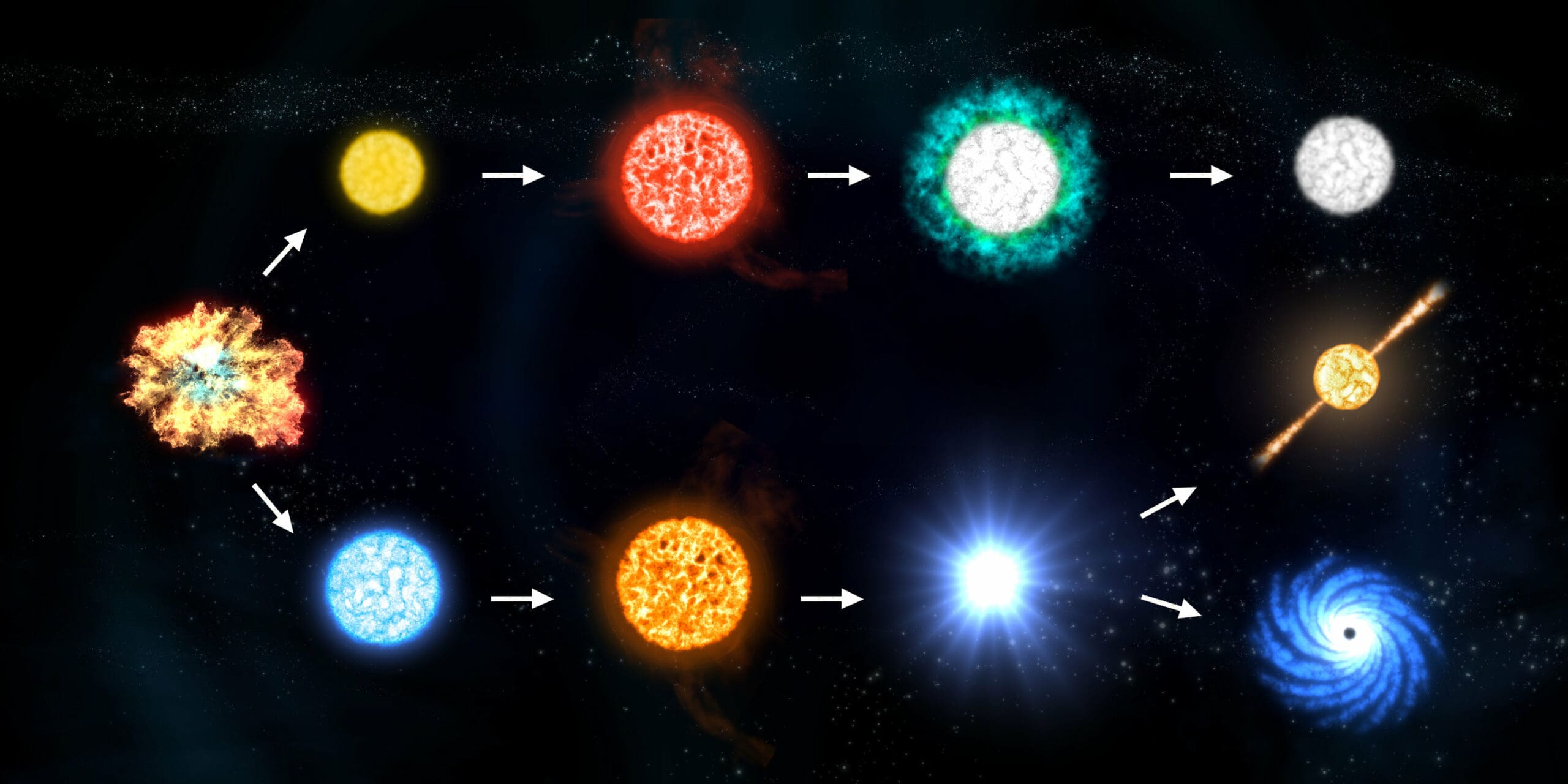
For stars with a mass comparable to the Sun (up to about 8 solar masses), death is a slow, transformative expansion rather than an instantaneous explosion. As the star exhausts the hydrogen in its core, the hydrostatic equilibrium is broken. The core, now composed of helium, contracts and heats up, while the outer layers expand and cool, turning the star into a Red Giant. [2] During this phase, the star may engulf its inner planets; when our Sun reaches this stage in approximately 5 billion years, it will likely expand to the orbit of Earth. In the core, temperatures eventually rise enough to fuse helium into carbon and oxygen, temporarily stabilizing the star again.
However, these stars lack the gravitational mass to fuse elements heavier than carbon. Eventually, the outer layers are ejected gently into space, driven by pulsations and stellar winds. This ejected material forms a Planetary Nebula—a misnomer, as it has nothing to do with planets—creating expanding shells of glowing, ionized gas that are among the most beautiful objects in the cosmos. The core that remains is exposed as a White Dwarf. [2] This stellar remnant is no longer powered by fusion but is supported against gravity by electron degeneracy pressure—a quantum mechanical effect where electrons resist being squeezed into the same energy state. A white dwarf packs the mass of the Sun into a volume roughly the size of Earth, creating an object of incredible density. Over billions of years, it will slowly radiate its residual heat away, fading into a theoretical black dwarf. [7]
High-Mass Evolution: Supernovae, Neutron Stars, and Nucleosynthesis
Stars born with more than 8 solar masses face a violent and catastrophic destiny that serves as the engine of creation for the universe. [2] These supergiants have cores hot enough to fuse heavier elements, progressing through a sequence of nuclear burning stages: carbon, neon, oxygen, and silicon. This process is stellar nucleosynthesis. However, this chain reaction hits an impassable wall at iron. Fusing iron consumes energy rather than releasing it. The moment a high-mass star forms an iron core, the outward pressure ceases instantly. Gravity wins the war in a fraction of a second, causing the core to collapse at 25% the speed of light.
The resulting rebound causes a Type II Supernova, an explosion so bright it can outshine an entire galaxy. This explosion is responsible for the "r-process" (rapid neutron capture), which synthesizes elements heavier than iron, such as gold, platinum, and uranium, and scatters them across the cosmos. What remains of the core depends on the mass. [2] If the core is between 1.4 and 3 solar masses, it becomes a Neutron Star, an object so dense that protons and electrons merge to form neutrons. A teaspoon of neutron star material would weigh billions of tons. [8] If the core remains more massive than 3 solar masses, even neutron degeneracy pressure fails. [8] The core collapses infinitely, piercing the fabric of spacetime to form a Black Hole, an object with gravity so intense that not even light can escape its event horizon. [9][10] These remnants are the gravestones of titans, yet the elements they ejected are the building blocks of planets and life itself.