



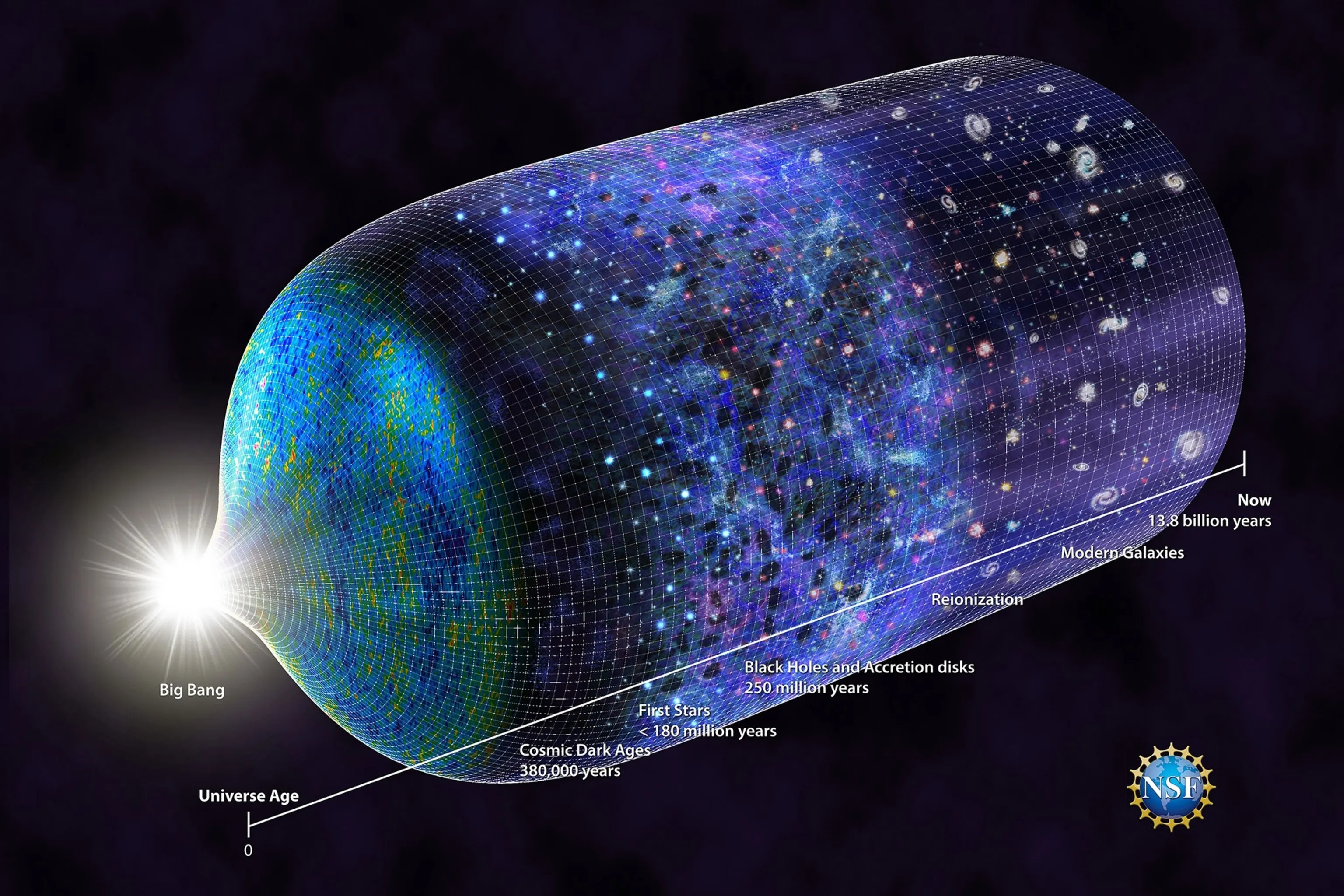
The Big Bang Theory and the Origin of the Universe.
The Genesis of Spacetime: A Comprehensive Analysis of the Big Bang Model
I. The Nature of the Event: Expansion, Not Explosion [1]
The Big Bang Theory stands as the paramount achievement of modern cosmology, offering a robust framework for understanding the genesis and evolution of the observable universe. However, to grasp its profundity, one must first dismantle the most pervasive misconception surrounding it: the Big Bang was not an explosion in space, but rather an explosive expansion of space itself. [2] Approximately 13.8 billion years ago, the entirety of our cosmos—every photon of light, every ounce of matter, and the very fabric of spacetime—was compressed into a singularity, a point of infinite density and temperature. [2] This was not a chaotic detonation occurring within a pre-existing void; rather, it was the moment when the clock of time began to tick and the canvas of space began to unfurl.
The physics governing this initial state defies our current understanding of the natural world. [3] In that primordial moment, the distinctions between energy and matter were non-existent. [2][3] The universe did not expand into "nothingness" because there was no "outside" to expand into; the universe contained everything that existed. [3] As space stretched, it carried matter with it, much like coins glued to the surface of an inflating balloon move apart not because they are swimming across the rubber, but because the surface itself is growing. [2] This distinction is vital for understanding the uniformity of the cosmos. [3] If it were a simple explosion, matter would be distributed unevenly, with a central point of origin. [2] Instead, we observe that galaxies are receding from us in all directions, implying that every point in the universe can claim to be the center of the expansion. This concept of metric expansion is the bedrock upon which all modern astronomical observation rests, transforming our view of the heavens from a static backdrop into a dynamic, evolving entity. [2]
II. The Cosmic Chronology: From Quantum Chaos to the First Light
The history of the universe is a narrative of cooling and organization, a transition from chaotic energy to structured matter. [4] This chronology is divided into distinct epochs, each governed by specific physical laws. [2][3] The timeline begins with the Planck Epoch (0 to $10^{-43}$ seconds), a period so brief and hot that the four fundamental forces of nature—gravity, electromagnetism, and the strong and weak nuclear forces—were unified into a single superforce. [4][5] Following this was the Inflationary Epoch, a fraction of a second where the universe underwent a violent, exponential expansion, growing from the size of a subatomic particle to a macroscopic volume faster than the speed of light. [4][5] This rapid inflation smoothed out the irregularities of the early cosmos, ensuring the large-scale homogeneity we observe today.
As the universe continued to expand, it cooled sufficiently for the first particles to emerge. [4][5] By the three-minute mark, the universe had transformed into a searingly hot nuclear fusion reactor. [2] During this period, known as Big Bang Nucleosynthesis, protons and neutrons collided with enough force to fuse into the first atomic nuclei. [2][4] In these critical minutes, the chemical composition of the cosmos was set: roughly 75% hydrogen, 25% helium, and trace amounts of lithium. [2][4] However, for the next 380,000 years, the universe remained an opaque "fog" of plasma. [2] It was too hot for electrons to orbit nuclei, meaning light (photons) was constantly scattered by free electrons, trapped in a cosmic pinball game. [2][3] It was only during the Epoch of Recombination, when temperatures dropped to roughly 3,000 Kelvin, that atoms finally formed. [2] The fog cleared, and the first light streamed across the universe—a moment of transparency that released the radiation we can still detect today.
III. [2][3] The Pillars of Evidence: Whispers from the Beginning
The scientific confidence in the Big Bang Theory is not derived from speculation but from three distinct, interlocking pillars of observational evidence that no other theory can adequately explain. The first pillar is the Cosmic Microwave Background (CMB). [6][7] Discovered largely by accident in 1965 by Arno Penzias and Robert Wilson, the CMB is the "afterglow" of the Big Bang—the relic radiation released during the Epoch of Recombination. It appears as a faint microwave signal detectable in every direction of the sky, with a nearly uniform temperature of 2.7 Kelvin. [2][3] The existence of this radiation matches the precise predictions of a hot, dense early universe that has cooled over billions of years. [3] It is, effectively, a baby picture of the cosmos, showing us the universe as it was before stars or galaxies existed. [2]
The second pillar is the abundance of primordial elements. [3] If the universe began in a hot, dense state, nuclear physics predicts that the fusion of hydrogen into helium would have occurred efficiently but briefly. [2] Calculations suggest this should result in a universe composed of approximately 25% helium by mass. [2][3] When astronomers analyze the oldest gas clouds in the distant universe—regions untouched by the contamination of later stellar generations—they find exactly this ratio. The third pillar is the expansion of the universe itself, quantified by Hubble’s Law. By measuring the "redshift" of light from distant galaxies, Edwin Hubble demonstrated that galaxies are moving away from us, and their speed is proportional to their distance. [2][8] This observation forces the logical conclusion that if one were to rewind the cosmic film, all matter would converge at a single point of origin. These three pillars transform the Big Bang from a hypothesis into a verified historical model. [2][3]
IV. The Invisible Architects: Dark Matter and the Accelerating Cosmos [9]
While the Big Bang Theory explains the origin of the visible universe, modern cosmology has revealed that visible matter—the stars, planets, and gas we can see—comprises less than 5% of the total energy budget of the cosmos. The evolution of the universe has been silently guided by two mysterious components: Dark Matter and Dark Energy. [3][9] Dark Matter, which makes up about 27% of the universe, acts as the gravitational "scaffolding" of the cosmos. [10] Without the extra gravity provided by this invisible substance, the early universe would not have been able to pull gas together to form the first galaxies; they would have flown apart due to their own rotation. We cannot see Dark Matter, but we observe its influence in the way it bends light (gravitational lensing) and holds galaxy clusters together. [2][3]
Even more enigmatic is Dark Energy, constituting roughly 68% of the universe. [2][10] In the late 1990s, astronomers studying distant supernovae made a startling discovery: the expansion of the universe is not slowing down as gravity should dictate, but is instead accelerating. Dark Energy is the theoretical force driving this acceleration, pushing galaxies apart at ever-increasing speeds. [2][3] This discovery has profound implications for the ultimate fate of the universe. [3] Rather than collapsing back into a "Big Crunch," the influence of Dark Energy suggests a "Big Freeze" scenario, where the universe expands forever, eventually becoming cold, dark, and lonely as galaxies are pushed beyond the cosmic horizon. [2] Thus, the Big Bang theory is not just a story of the past; it is a framework that incorporates these invisible forces to predict a dynamic, ever-changing future where the geometry of space continues to evolve.