



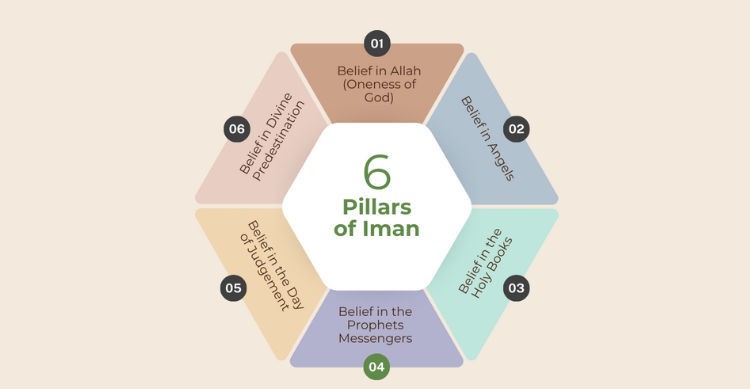
The Six Pillars of Faith: A Detailed Explanation of Each Pillar.
The Six Pillars of Faith, known in Arabic as "Iman," constitute the fundamental theological framework of Islam, providing a comprehensive worldview that defines a Muslim's relationship with the Divine and the universe. These pillars are distinct from the Five Pillars of Islam, which outline ritualistic practices, yet both sets are indispensable for a complete and genuine Islamic faith [1][2]. The Six Pillars delve into the core convictions that shape a believer's spiritual identity, guiding their understanding of existence, purpose, and destiny.
1. Belief in Allah (God)The paramount pillar of faith is the absolute belief in Allah (God) as the singular, unique, and ultimate Creator, Sustainer, and Sovereign of all existence. This foundational concept, known as Tawhid, underscores the absolute Oneness of God and unequivocally rejects any form of polytheism or idolatry [1][3]. Tawhid is meticulously expounded through three interconnected aspects that provide a profound understanding of Allah's nature and His relationship with creation.
Firstly, Tawhid ar-Ruboobiyyah (Oneness of Lordship) affirms Allah as the sole Creator, Provider, and Controller of everything. This means acknowledging that all acts of creation, sustenance, giving life, causing death, and governing the cosmos originate solely from Him [4][5]. Nothing occurs in the universe without His explicit will and knowledge, establishing His absolute dominion over all affairs. This belief instills a deep sense of dependence on Allah and gratitude for His continuous provision.
Secondly, Tawhid al-Asma was-Sifaat (Oneness of Names and Attributes) mandates belief in Allah's perfect attributes as revealed in the Quran and authentic prophetic traditions (Sunnah). Muslims affirm all the names and attributes Allah has ascribed to Himself, such as Al-Rahman (The Most Merciful), Al-Alim (The All-Knowing), and Al-Qadir (The All-Powerful), without distortion, denial, or anthropomorphism [6][7]. This aspect emphasizes that Allah is utterly unique, and nothing in creation resembles Him in His essence or attributes, fostering reverence and awe for His incomparable perfection [8].
Thirdly, Tawhid al-Uloohiyyah (Oneness of Divinity/Worship) asserts that only Allah is worthy of worship. This necessitates directing all acts of devotion, including prayer, supplication, sacrifice, and reliance, exclusively to Him [5][7]. This is considered the ultimate purpose for which humanity was created and prophets were sent, serving as the core message of all divine revelations. Embracing Tawhid al-Uloohiyyah transforms a Muslim's life into an act of continuous worship, fostering humility, sincere devotion, and an unwavering reliance on the Divine [7][9].
2. Belief in AngelsThe second pillar requires belief in angels, unseen celestial beings created by Allah from light. Unlike humans, angels are entirely subservient to Allah's will, possessing no free will of their own and never disobeying His commands [8][10]. Their existence reinforces the reality of the unseen world and Allah's meticulous organization of His creation.
Angels are assigned diverse and significant roles within the cosmic order. Among the most prominent are Jibreel (Gabriel), who is entrusted with delivering divine revelations to prophets, most notably the Quran to Prophet Muhammad [11][12]. Mika'il (Michael) is responsible for the distribution of sustenance, including rain and vegetation, demonstrating Allah's provision through His agents [11]. Israfil is designated to blow the trumpet, signaling the commencement of the Day of Judgment [11]. The Angel of Death, Malak al-Mawt, is responsible for collecting souls at their appointed time [11][13]. Furthermore, two recording angels, known as Kiraman Katibin, are assigned to every individual to meticulously document all good and bad deeds, providing a comprehensive record for the Day of Judgment [14][15]. Other angels serve as guardians, protecting individuals by divine command, and continuously glorify Allah without fatigue [8][15]. Belief in angels underscores Allah's omnipresence and His intricate system of governance, inspiring believers to uphold righteousness, knowing their actions are constantly observed and recorded [10][11].
3. Belief in Holy Books (Scriptures)The third pillar of faith is the conviction that Allah has, throughout history, revealed divine scriptures to various prophets as a source of guidance for humanity. These sacred texts contain Allah's messages, laws, and warnings, illuminating the path to righteousness and success in both this life and the hereafter [16][17].
Muslims believe in the divine origin of several holy books, including the Scrolls (Suhuf) given to Prophet Abraham and Moses, the Psalms (Zabur) revealed to Prophet David, the Torah (Taurat) given to Prophet Moses, and the Gospel (Injil) bestowed upon Prophet Jesus [16][18]. The Quran, revealed to Prophet Muhammad, is considered the final and most complete of these scriptures. A crucial aspect of this belief is the understanding that while previous scriptures were divinely revealed, they underwent alterations or corruptions over time, a concept known as tahrif [16][18]. The Quran, however, is believed to have been preserved in its original form since its revelation, serving as a confirmation of the true messages of previous books and a final authority over them [16][18]. The holy books provide moral guidance, foster a spiritual connection with the Divine, and offer profound insights into the purpose of human existence, thereby unifying communities around shared divine principles [17][19].
4. Belief in Prophets and MessengersThe fourth pillar entails belief in all prophets (Nabi) and messengers (Rasul) sent by Allah. These chosen individuals served as divine conduits, delivering Allah's revelations and guiding humanity towards monotheism and righteous living [20][21]. While the terms 'prophet' and 'messenger' are often used interchangeably, Islamic scholarship distinguishes them: a Nabi receives revelation for personal guidance and to teach their people, while a Rasul (messenger) brings a new divine law (Shariah) or reaffirms an existing one to a specific community or humanity at large [21].
Allah sent messengers to every nation throughout history, ensuring that no community was left without divine guidance [20][22]. Among the most recognized prophets in Islam are Nuh (Noah), Ibrahim (Abraham), Musa (Moses), Isa (Jesus), and Muhammad (peace be upon them all) [20]. Each prophet conveyed the same fundamental message: the worship of Allah alone and adherence to His commands. Prophet Muhammad is revered as the "Seal of the Prophets," signifying that he is the last prophet in this sacred lineage, and the Quran revealed to him represents the culmination and perfection of divine guidance for all of humanity until the Day of Judgment [20][22]. Prophets are not merely historical figures but serve as exemplary role models, embodying the highest moral and ethical standards, and their lives offer profound lessons in faith, perseverance, and submission to God's will [21][23].
5. Belief in the Day of JudgmentThe fifth pillar is the profound belief in the Day of Judgment, also known as the Last Day or Yawm al-Qiyamah. This belief asserts that earthly life is not an end in itself but a prelude to an eternal afterlife, where every individual will be resurrected and held accountable for their deeds, intentions, and beliefs [24][25]. This doctrine is a central tenet, serving as a powerful motivator for ethical conduct and a reminder of ultimate divine justice.
On this momentous day, all human beings will be resurrected from their graves to stand before Allah, the Supreme Judge [24][25]. Each person's life will be meticulously reviewed, with their deeds, both good and bad, presented in a comprehensive record [8][26]. These actions will then be weighed on a divine scale (Mizan), ensuring absolute fairness and that no soul is wronged [26]. The outcome of this judgment will determine one's eternal abode: either the bliss of Heaven (Paradise) or the torment of Hell [25][26]. The belief in the Day of Judgment fosters a deep sense of responsibility, encouraging believers to live righteously, seek forgiveness, and strive for justice, knowing that true recompense awaits beyond this transient world [26].
6. Belief in Divine Decree (Qadar)The sixth and final pillar is the belief in Divine Decree, or Qadar, which signifies the conviction that everything that occurs in the universe, whether good or bad, is by the will and knowledge of Allah [8][27]. Allah's knowledge is perfect and eternal, encompassing all events that have happened, are happening, and will happen, all of which are recorded in Al-Lawh Al-Mahfuz (The Preserved Tablet) [27]. This concept emphasizes Allah's absolute sovereignty and control over all creation.
Crucially, the belief in Qadar does not negate human free will or individual accountability. Islamic theology maintains a delicate balance: while Allah has foreknowledge and has decreed all events, humans are endowed with the capacity to choose their actions, for which they will be judged [27][28]. The divine decree unfolds in four stages: Allah's eternal knowledge (Ilm), His recording of everything (Kitabah), His divine will (Mashiah), and His creation of events (Khalq) [27][29]. This understanding encourages individuals to exert their best efforts, make sincere supplications, and then place their ultimate trust in Allah's plan (Tawakkul) [27]. It provides believers with inner peace and resilience in the face of adversity, knowing that even hardships are part of a greater divine wisdom, while simultaneously motivating them to strive for good, as their choices contribute to their decreed destiny [27].
Conclusion
The Six Pillars of Faith collectively form the bedrock of Islamic belief, offering a profound and coherent framework for understanding existence, morality, and purpose. From the absolute Oneness of Allah to the certainty of divine judgment and decree, these pillars are intricately interconnected, each reinforcing the others. They provide Muslims with a clear spiritual compass, guiding their actions, shaping their character, and fostering a deep, unwavering connection with their Creator. Embracing these tenets transforms a mere intellectual assent into a living, dynamic faith that permeates every aspect of life, inspiring individuals to live purposefully, ethically, and in complete submission to the Divine will.