



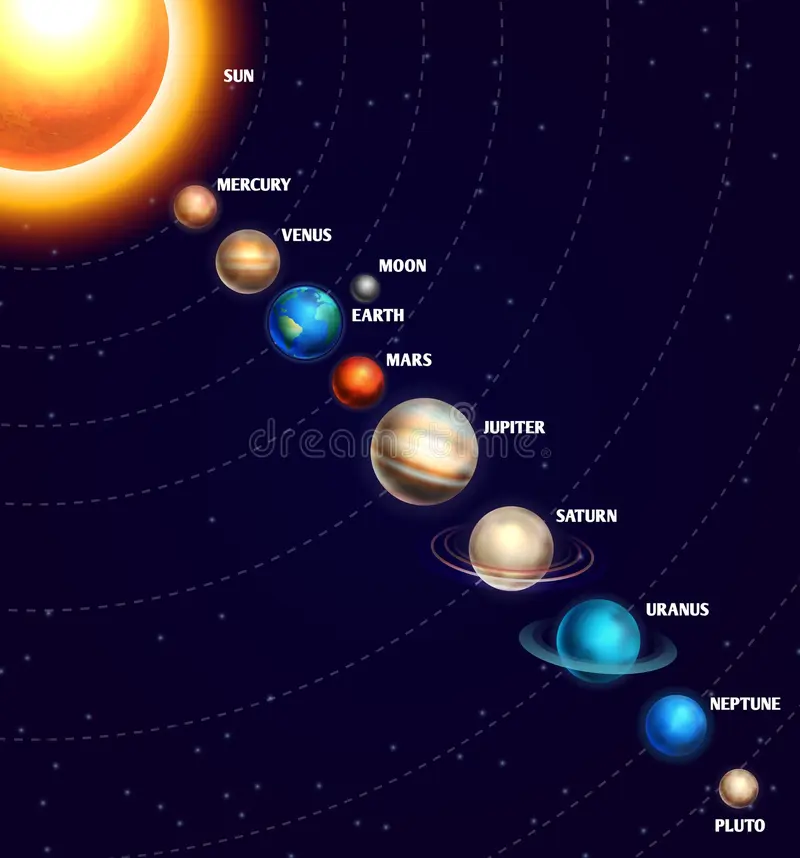
The Solar System: Planets, Moons, and Asteroids.
The Solar System: A Cosmic Archipelago
1. The Solar Dominance and the Heliospheric Bubble
The Solar System is not merely a collection of rocks and gas; it is a dynamic, gravitationally bound engine dominated entirely by the Sun. This G-type main-sequence star accounts for 99.86% of the system's total mass, a staggering statistic that renders all planets, from Jupiter to Earth, as mere debris in comparison. [1] The Sun functions as a colossal fusion reactor, converting 600 million tons of hydrogen into helium every second via the proton-proton chain. This process generates the light and heat that sustain life on Earth, but it also creates a violent environment. The Sun emits a constant stream of charged particles known as the solar wind, which travels at supersonic speeds, inflating a magnetic bubble called the heliosphere.
This bubble acts as our shield against the interstellar medium. The true scale of this influence was realized only recently when the Voyager 1 spacecraft, launched in 1977, crossed the "heliopause" in 2012, entering interstellar space at a distance of over 15 billion miles from Earth. It confirmed that our solar system is effectively a fortress, protected from galactic cosmic rays by the Sun's magnetic influence. However, this protection is not static; the Sun is a variable star. Its 11-year cycle of magnetic activity produces solar flares and coronal mass ejections (CMEs) capable of stripping atmospheres from planets that lack their own magnetic fields—a fate that likely befell Mars billions of years ago.
2. [1][2] The Terrestrial Worlds: The Goldilocks Paradox
The inner solar system presents a stark lesson in planetary evolution, often described as the "Goldilocks Paradox." Mercury, Venus, Earth, and Mars were all formed from similar primordial materials, yet their fates diverged radically. [1] Mercury, the closest to the Sun, is a scorched, airless husk with a massive iron core, likely the remnant of a larger planet stripped by a cataclysmic impact. Venus, often called Earth’s twin due to similar size and composition, serves as a cautionary tale of climate apocalypse. [1] Its thick atmosphere, composed of 96% carbon dioxide, traps heat so efficiently that surface temperatures exceed 475°C (887°F)—hot enough to melt lead. [1] It is a world where it rains sulfuric acid, yet the surface remains dry because the heat evaporates the droplets before they land.
In contrast, Mars represents a frozen tragedy. [1] Once a wet world with rivers and lakes, it lost its magnetic field and subsequently its atmosphere to the solar wind. However, it remains the primary target for the search for ancient life. The Perseverance rover, currently exploring the Jezero Crater, has identified sedimentary rocks confirming that a deep lake existed there 3.7 billion years ago. In 2024 and 2025, analysis of the "Cheyava Falls" rock sample revealed organic molecules and chemical signatures potentially consistent with microbial life, though non-biological processes have not yet been ruled out. This ongoing exploration underscores that Earth—with its liquid water, active plate tectonics, and protective magnetosphere—is a fragile anomaly in a hostile neighborhood. [1]
3. The Giant Planets: Gravity Wells and Ocean Worlds
Beyond the "Frost Line," where volatile compounds like water and ammonia freeze, lie the giants. Jupiter is a failed star in its own right, composed mostly of hydrogen and helium. [1] Its immense gravity acts as a chaotic steward for the inner solar system, occasionally shielding Earth from comets but just as often hurling asteroids toward us. Jupiter’s Great Red Spot, a storm larger than Earth, has raged for centuries, though recent observations show it is shrinking. [1] However, the true intrigue of the Jovian system lies in its moons. Europa, encased in a shell of ice, hides a subsurface ocean containing twice the water of all Earth’s oceans combined. It is widely considered one of the most likely places to find extraterrestrial life today.
Saturn, distinguished by its complex ring system, has recently dethroned Jupiter as the "Moon King." [1] As of late 2024, Saturn boasts 146 confirmed moons, compared to Jupiter’s 95. [1] Among them is Enceladus, a small icy moon that actively shoots geysers of salty water into space. [1] The Cassini mission flew through these plumes, detecting organic compounds—the building blocks of life. Further out, the "Ice Giants" Uranus and Neptune differ from their larger siblings; they are composed of heavier elements and "ices" (water, methane, ammonia). [1] Uranus rotates on its side, likely the victim of a massive ancient collision, while Neptune experiences the fastest winds in the solar system, reaching supersonic speeds of 1,200 mph.
4. The Small Bodies: Time Capsules and Planetary Defense
The "debris" of the solar system—asteroids and comets—are not merely space rocks; they are the pristine time capsules of our origins. The Asteroid Belt between Mars and Jupiter is the construction yard of a planet that never formed. In October 2023, NASA’s OSIRIS-REx mission successfully returned a sample from the asteroid Bennu. [3][4] Analysis revealed high concentrations of carbon and water-bearing clay minerals, supporting the theory that asteroids may have delivered the essential ingredients for life to the early Earth. [3][4] This connects our biological history directly to the cosmic rubble orbiting millions of miles away.
Furthermore, these bodies represent an existential threat that humanity is learning to manage. [1] The Chicxulub impactor, which extinguished the dinosaurs 66 million years ago, proved that the solar system is a violent place. In response, humanity conducted the DART mission (Double Asteroid Redirection Test) in 2022, successfully crashing a spacecraft into the asteroid Dimorphos and altering its orbit. This marked the first time in history that a species has measurably changed the celestial mechanics of the solar system for its own defense. From the Kuiper Belt (home to Pluto and Arrokoth) to the distant Oort Cloud, these small bodies define the boundaries of our home and hold the chemical recipe that made us possible.